
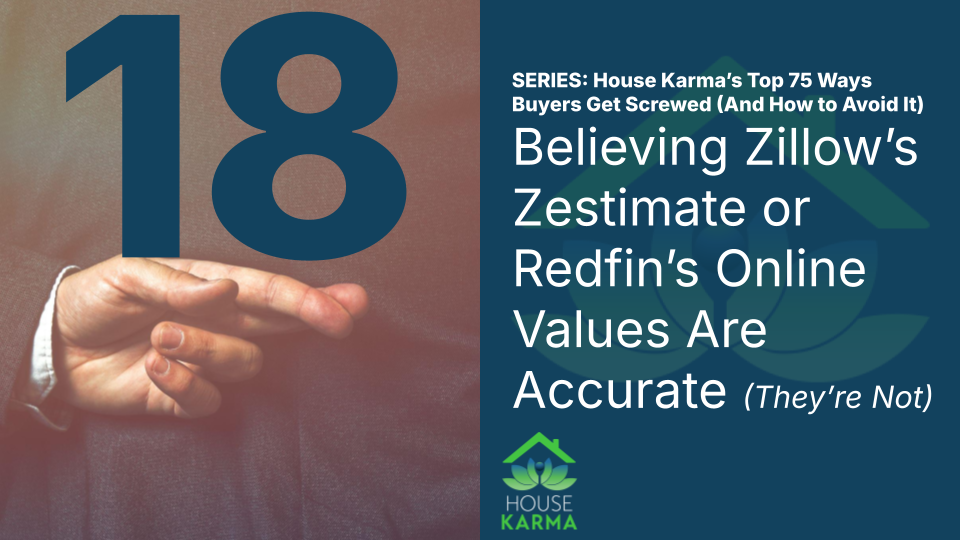
They’re great for browsing — but not for betting the biggest purchase of your life
We live in an age where buyers have access to more property info than ever before. You can scroll listings on Zillow, Redfin, Realtor.com, and dozens of other sites at any time of day. It’s fun. It’s addicting. It’s empowering.
But here’s where buyers go wrong:
Just because a number is on a screen doesn’t mean it’s accurate.
Whether it’s called a Zestimate, Redfin Estimate, or anything else — these are computer-generated guesses, not professional valuations. And while they can be close sometimes… they can also be wildly off.
What Zestimates Can Do — and What They Can’t
Let’s be fair.
Sites like Zillow, Redfin, and Homes.com actually get the estimated value pretty close about 70%–80% of the time — usually within 3–5% of what the home might sell for.
That makes them a useful starting point for comparison shopping.
But they’re just algorithms — and no algorithm can walk into a house and say:
- “This layout is a nightmare.”
- “This home backs up to a gas station.”
- “This one has a second lot — that adds serious value.”
- “This one has a dated kitchen but perfect bones.”
- “The neighbor’s roof is caving in.”
Those are the things that real buyers see — and real agents know.
Every Property Is Unique — Even if the Model Isn’t
Online estimates pull sales data from nearby homes and try to calculate a fair market value. But they can’t factor in the real-world differences between one home and the next.
Let’s say:
- One home backs up to another backyard
- The identical model across the street backs up to a golf course
Zillow might value them the same. You and I both know they’re not.
Or:
- Two homes are side-by-side, same year, same square footage
- One has a brand-new roof and HVAC, the other has systems on their last leg
Again, there is a big difference in value — but not something an online estimate can accurately reflect.
What About Functional & Economic Obsolescence?
These are industry terms, but they matter:
- Functional obsolescence = bad layouts, outdated design, awkward spaces that can’t easily be fixed
- Economic obsolescence = external factors like noisy roads, commercial properties nearby, or declining neighborhoods
Online values don’t see those things. But you will — and so will your lender, appraiser, and future buyer if you ever sell.
Real Value = A Mix of Data, Experience, and Market Savvy
At the end of the day, a house is worth what a ready, willing, and able buyer is willing to pay for it — and that number depends on far more than a website estimate.
That’s where a good agent or broker earns their keep.
They understand the local market, the buyer psychology, the current inventory, and the fine details that make a home’s true value what it is.
Whether you’re buying or selling, you need someone who can explain:
- Why is one home worth $450K and another is worth $425K
- Why a house priced at $499K might really be worth $475K
- When it’s worth bidding higher — and when to walk away
House Karma’s Take
Use those sites. Browse. Compare. Learn.
We encourage it. In fact, we’ll even teach you how to spot patterns and price trends using online tools.
But when it comes time to make an offer or determine what a home is really worth to you — that’s where the online guesswork ends and real guidance begins.
Our House Karma brokers are trained to help you:
- Interpret comps
- Understand current trends
- Spot hidden value (or danger zones)
- And make smart, not emotional, decisions
Bottom Line
Zestimates and online values are a tool, not a truth.
They’re a great way to get familiar with pricing and neighborhoods — but they are not the final word on what any one house is truly worth.
When it’s time to buy, lean on real-world experience, not just real-time algorithms.
That’s why we’re here — to make sure your home isn’t just a good idea on paper… but a smart investment in real life.